Prototyping Participatory Governance
Architecting collaborative governance through sociocracy and shared power
Context
Following the departure of the organization’s beloved director, they faced a critical opportunity to rethink how power, decision-making, and accountability could be distributed across teams rather than centralized by one person.
Rather than reinforcing traditional hierarchical structures, we sought to prototype a more participatory, adaptive governance model that could increase resilience, empower staff, and align operational systems with organizational values.
This created the conditions for a strategic redesign of leadership infrastructure, governance architecture, and organizational processes.
Challenge
How might we redesign organizational governance to decentralize decision-making, distribute leadership, and build operational systems that support shared power?
Outcomes
The project resulted in the successful design and rollout of a participatory governance infrastructure that redefined how leadership, accountability, and collaboration functioned across the organization.
-
New organizational governance architecture
Circle-based leadership structures
Strategic governance implementation roadmap
Decision-making frameworks
Proposal and alignment tools
Onboarding systems for governance participation
Facilitation workshops
-
Distributed leadership capacity across teams
Reduced reliance on centralized authority
Improved organizational adaptability
Increased staff agency and participation
Established repeatable governance systems
Strengthened organizational resilience during transition
Embedded systems for collaborative accountability
Created frameworks for long-term leadership sustainability
Approach
The project applied systems design, organizational strategy, and participatory facilitation to prototype a governance framework rooted in sociocracy, shared leadership, and adaptive organizational design.
The transformation followed a multi-phase strategy:
Researched governance models, including sociocracy, holacracy, and distributed leadership systems to identify best-fit principles
Facilitated strategic design processes to translate governance theory into practical organizational structures
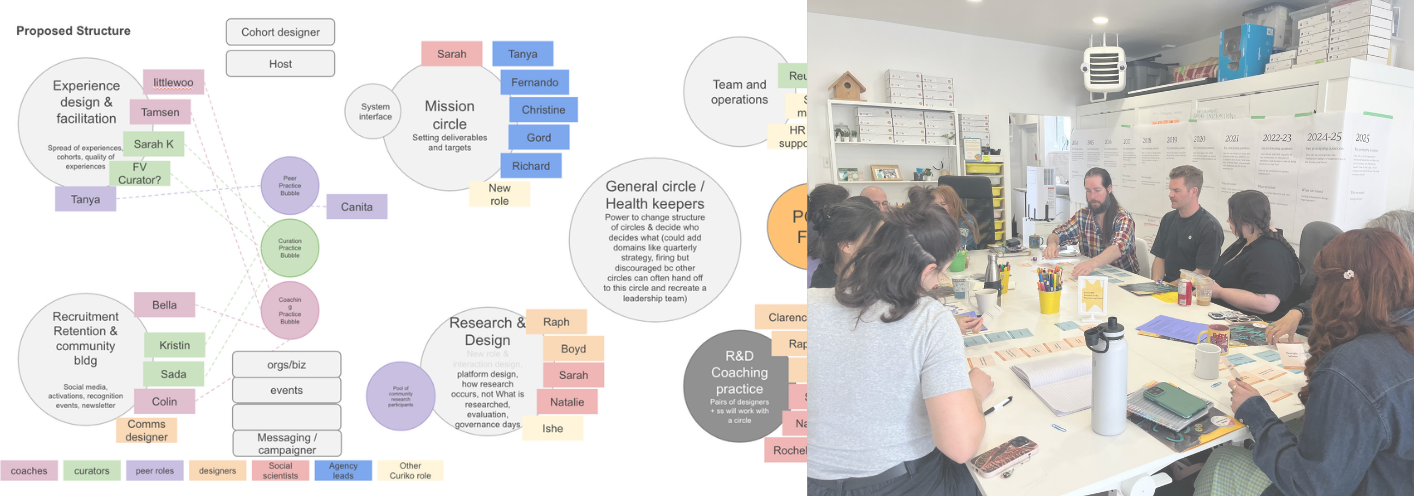
Designed new circle-based governance architecture, including team roles, responsibilities, domains, and decision-making pathways
Built implementation roadmaps for phased organizational transition
Developed governance tools and operational frameworks, including:
Proposal development tools
Alignment practices
Decision protocols
Led facilitation of governance design circles and implementation teams to support organizational buy-in
Roles: Lead Designer, Facilitator
Collaborators: Dr. Sarah Schulman, Janey Roh, Ted Rau